As the earth turns silver by Alison Wong won the Fiction Award at the 2010 NZ Post Book Awards this weekend. Judge Charmayne Poultney said ‘Based on meticulous research, this novel opens new windows on the development of our nation; it also opens our hearts to the anguish caused by racism, ignorance, failures in family relationships and communication, and war. The book is a delight to look at and hold, as well as deeply moving to read,’ The author herself said that she was inspired by her own family history and informed by her research but that she wanted to write about what it feeels like to be in such situations. In discussing her approach to writing, Alison Wong explained her love of beautiful language, she still writes poetry, and mentioned reading the works of Marilynne Robinson. Brian Turner, who won the Poetry Award, also noted the poetic language of Gilead and Home by Robinson. They are absorbing reads.
Always in the running for the Fiction Award, I put in my vote for As the earth turns silver for the People's Choice Award. This year the popular vote went to Al Brown's Go Fish, a "cook book with attitude" - lots of recipes, helpful hints, beautiful photos and important messages about food and sustainability.
Sunday, August 29, 2010
Sunday, August 15, 2010
The book or the film?
This is a topic that comes up at BookChats often; should we read the book before seeing the film? can we see the film without having read the book? shall we see the film instead of reading the book? why bother with the film if the book was good? I am reliably informed that although an excellent film The Girl with the dragon tattoo is infinitely better in book format because there is so much more story in the book. I cannot comment on this as I have neither read the book nor seen the film and probably will not do so. But that does suggest that the book and the film can be seen not only as different media but also as different stories.
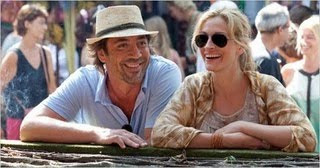
I have just been reading and watching the film previews of Eat, pray, love and think that this might be the case here. I enjoyed about half of the book: the whole of Italy, about a third of India and just some of Indonesia. If the film has picked out the best bits and given them some flow and cohesion, then I'll be pleased to watch.
The best example I can give of both a successful book and film is The Time traveler's wife. Yes, there are more episodes and descriptions in the book and more soul searching but the film was poignant and brought out the daughter's story very well.
I think books into films will continue to be an interesting topic for discussion - there is a brilliant, although not completely up to date, list at Based on the book. Happy reading and viewing!
I have just been reading and watching the film previews of Eat, pray, love and think that this might be the case here. I enjoyed about half of the book: the whole of Italy, about a third of India and just some of Indonesia. If the film has picked out the best bits and given them some flow and cohesion, then I'll be pleased to watch.
The best example I can give of both a successful book and film is The Time traveler's wife. Yes, there are more episodes and descriptions in the book and more soul searching but the film was poignant and brought out the daughter's story very well.
I think books into films will continue to be an interesting topic for discussion - there is a brilliant, although not completely up to date, list at Based on the book. Happy reading and viewing!
Monday, August 9, 2010
What's in a novel?
I'm looking for a good story, interesting characters and a satisfying ending. Also that special something that makes the whole thing novel.
36 arguments for the existence of god by Rebecca Newberger Goldstein includes a debate on belief and faith and a description of ritual in a religious community. Not normally the domain of the novel, this book contains plenty of philosophy, anthropology, psychology and theology. I found it all fascinating and thought-provoking. The author has been both praised and criticised for her erudite approach.
A similar response occured in British reviews when A.S. Byatt published The Children's Book suggesting that she was too clever and was showing off her knowledge of art, literature, culture in the Edwardian era. I loved this book too; it had all the appeal factors listed above but it also helped me understand more about fabianism and early writing for children for example.
If you like a good dense read with some challenging ideas try these novels from two well-educated writers.
36 arguments for the existence of god by Rebecca Newberger Goldstein includes a debate on belief and faith and a description of ritual in a religious community. Not normally the domain of the novel, this book contains plenty of philosophy, anthropology, psychology and theology. I found it all fascinating and thought-provoking. The author has been both praised and criticised for her erudite approach. A similar response occured in British reviews when A.S. Byatt published The Children's Book suggesting that she was too clever and was showing off her knowledge of art, literature, culture in the Edwardian era. I loved this book too; it had all the appeal factors listed above but it also helped me understand more about fabianism and early writing for children for example.
If you like a good dense read with some challenging ideas try these novels from two well-educated writers.
Labels:
books
Sunday, August 1, 2010
Who's telling the story?
It's no secret that I read books mostly by women authors as I can relate better to the female perspective. And then along comes a male writer who writes a female character very effectively. In Brooklyn, Colm Toibin describes two years in the life of Eilis who leaves Ireland in the Fifties for a better life (or so it seems) in America. The voices in this novel are predominanatly female with the male characters mostly playing minor parts. The three major males are very kind and sympathetic men, making this appear to be a gentle read. It does however raise some important questions about family and loyalty and appreciation of others and can best be described as a thoughtful read. My list of favourite male authors has now increased to three!
Sometimes I also experience difficulty with a female writer who takes on a male perspective but was pleasantly surprised by Lionel Shriver's latest book So much for that. Shriver's narrator ends up caring for three sick people from different generations - some special person. This well developed story has a political and financial theme but it is the way the individuals deal with their problems that moves the story along and makes the male voice quite acceptable!
Labels:
books
Saturday, July 24, 2010
Poetry
National Poetry Day, this year on Friday 30 July, aims to involve as many people as possible in celebrating poetry, poets and poems. There are events all over the country and also newspaper and radio items and interviews. The New Zealand Post Poetry Award for 2010 will be announced in August.
Newly published, and not eligible for this year's poetry award, is a lovely little book by Fiona Kidman called Where your left hand rests. Within the attractive cover and endpapers are beautiful illustrations and fascinating poems that encapsulate a deep sense of family and history. Various images of Victorian embroidery separate the sections of the book but the repetition of a perfect rose provides continuity. This is a special book to hold, look through and read - a little treasure.
Saturday, July 17, 2010
Private life
The latest novel by Jane Smiley, Private life, describes the lifetime of one woman, a very private life indeed but it occurs over 70 years of public and significant events in American history including the 1905 San Francisco earthquake, the Great War, the Spanish flu epidemic and the Japanese attack on Pearl Harbour. What unfolds against this panarama of history is Margaret's internal struggle to understand herself and her relationships with those around her. In conversation with Kim Hill, Jane Smiley admitted that she set out to write an interesting story and used an eccentric character from her own family as a basis for Captain Andrew Jefferson Early. Posing the question "how does a normal person keep up with abnormality around them" Jane Smiley suggested the book could be seen as a parable for modern American society. I think what she has brilliantly achieved is a distillation of the many threads, forces and coincidences that shaped the life of Margaret and her sad marriage, into a symbolic study of selflessness.
Jane Smiley's book contains several other effective character studies; a Japanese midwife, an elusive male friend and the very independent Dora, a journalist who becomes a European war correspondent in 1916. Another novel worth reading with a female war correspondent, this time during the Second World War, is the Postmistress by Sarah Blake; also a study in the personal versus the political and how people cope in difficult situations.
Labels:
books
Friday, July 9, 2010
a book or a Kobo?
Not the right question? It's the content that matters. Ask instead - a novel or a biography, historical or contemporary, funny or serious, light or challenging?
What we read is more important than how and I am increasingly concerned about the articles and letters stating that the feel of a book, the smell of the pages is an integral part of the experience. For me it's the story every time.
Now I can choose to read a printed book or to download to my Kobo and I'm doing both quite happily. The pleasure of hunting out a good read and then getting hold of it and then just reading and reading - thank goodness it's the weekend!
The June issue of Good Reading Magazine, available by the way in print or online, included an article on music in novels. One title listed that I haven't read is now on my Kobo, immediate transfer, no waiting in a reserves queue or travelling to the bookshop and I can fit it easily into my bicycle basket.
What we read is more important than how and I am increasingly concerned about the articles and letters stating that the feel of a book, the smell of the pages is an integral part of the experience. For me it's the story every time.
Now I can choose to read a printed book or to download to my Kobo and I'm doing both quite happily. The pleasure of hunting out a good read and then getting hold of it and then just reading and reading - thank goodness it's the weekend!
The June issue of Good Reading Magazine, available by the way in print or online, included an article on music in novels. One title listed that I haven't read is now on my Kobo, immediate transfer, no waiting in a reserves queue or travelling to the bookshop and I can fit it easily into my bicycle basket.
Labels:
ebooks
Subscribe to:
Posts (Atom)